
IF WE ARE TO EXIST,
SUSTAINABILITY IS THE ONLY WAY TO FUNCTION
Our planet Earth is estimated to be around 4.5 billion years old, and since the first life appeared around a billion years later, the law of sustainability was put in place. Since then, everything has its place and its cycle in the great web of life. This self-regenerating system is a masterpiece of Nature that ensures the perfect, never-ending cycle.
This cycle has been completely forgotten within human society, and by unsustainable operations, we upset the fragile balance, and the Natural response to the unbalanced ecosystem is a great reset. In this case, mass extinction.
If we are to halt the current mass extinction and secure the future, we must convert all our operations to environmental sustainability.
PLASTIC
A substance we cannot imagine our lives without. From the first day we are born to the last, plastic is our everyday companion. However, it is not widely known that plastic is classed as an environmental and public health hazard with significant long-term dangers. A chemical substance that leeches harmful chemicals that cause estrogenic and cancer-causing activity. Yet, we not only come in contact with this dangerous substance on an everyday basis but also support its production.
Microplastics are tiny particles of broken-up plastic. These microplastics are now covering the planet, from the water to the air. We eat it, and we breathe it. Once they enter our system, large quantities get stuck in our bodies and burrow into the flesh. There, they leach the harmful chemicals.


PLASTIC PRODUCTION EXCEEDS 460 MILLION METRIC TONS
EACH YEAR
LESS THAN 10% (46 MILLION METRIC TONS) GETS SUCCESSFULLY RECYCLED
2O MILLION METRIC TONS LEACH INTO THE ENVIRONMENT EACH YEAR
UP TO 23 MILLION METRIC TONS POLLUTE OUR AQUATIC SYSTEMS EACH YEAR


EMISSIONS
Since the first industrial revolution in 1750, our human activities have been increasing the levels of CO2, methane, and other greenhouse gases in the atmosphere. This, combined with deforestation, rapidly disrupts the weather patterns, causes climate change, and so contributes to the collapse of life on Earth.
Fossil fuels, oil burning, industrial activities and landfills are amongst the largest sources of greenhouse gases.


DEFORESTATION
We are cutting down the very branch upon which we sit, would be the best metaphor for deforestation.
Our world’s forests are the lungs of our existence and also the air conditioning of our home. By converting CO2 to oxygen, the world's forests keep a healthy, balanced air for life to breathe. This carbon sequestration, combined with evapotranspiration and cloud formation, allows the world's forests to act as the Earth's cooling system.
Lastly, the world's forests are the home of the largest mass of biodiversity.
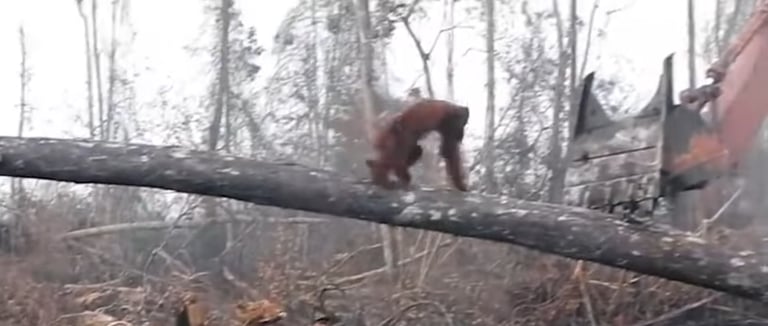
Legally illegal deforestation is practised across the globe. Sourced timber is sold to large companies, and the land is converted to intensive agriculture, such as livestock or crops.
Unsustainable Palm Oil Production is one of the most destructive agricultural practices. The land is often obtained by large-scale governmental corruption, legally illegal sourced timber is sold to large companies, the landscape and its surviving wildlife are cleared by napalm and the agricultural land is often built on modern-day slavery. These large-scale criminal activities span through Asia, Africa and Central and South America. Eventually, purchased and used by many mainstream products, such as food & beverage, hygiene products, beauty products, and even fuels.


Roughly 20 million square kilometres (about 50%) of the world's forests have declined due to human activity.
CO2 Levels:
yr. 1750 - 140 parts per million (ppm)
yr. 2026 - 428 parts per million (ppm)
Between 1970 and 2020, biodiversity declined by 73%.
The extinction rate is around 1000 times higher due to human-induced environmental issues


OVERPOPULATION
The ultimate elephant in the room of topics. Let's face it, too many is just too many.
Human overpopulation is the driving force and the hotspot of all environmental issues. The Earth has limited space and resources. Environmental sustainability is a balance. A balance between day and night, predator and prey, life and death, but also populations.
We have many instances of overpopulation of different species, which always result in hardships, shortage of food and water, intensified competition, etc. And even though we have much research data, or even a book called An Essay on the Principle of Population, from 1798 by Thomas R. Malthus, which has never been more relevant, the serious threat of an ever-growing human population has been widely ignored.


Searching for volunteer placements to enhance your career? Or are you an organisation that truly wants to make a change? Or are you an everyday person who just wants to do something for the future?
Whatever the enquiry might be, please do not hesitate to contact us to learn more. Our team of dedicated professionals are here to help!
CONTACT US
PHONE
+353 85 716 6328
© 2025. All rights reserved.